We work all our lives to create wealth for ourselves. Some of us have a desire to just ensure that we remain financially secure so long as we live and to some extent, a good start for our children – the next generation. Do we really have control over how well the third and subsequent generations fare? In a longitudinal study of 3,250 families conducted over 25 years by the US wealth consultancy, The Williams Group in 2002, the findings indicated that about 70% of a family’s wealth is lost by the second generation, and by the third generation it’s 90%. Across cultures – Japan, US, Italy and perhaps in other cultures too, is a mention of this phenomenon called “The Three Generation Curse”. The reasons for this outcome may vary –
- A change in the mindset across generations from hunger to grow to entitlement
- Dominance of earlier generations/ not giving enough opportunities to learn for the youngsters
- Breakdown of trust within the family members
- Dilution of wealth over generations with more members in the family
- Taxes
How can we define “Greed”? It is the intense and selfish desire for something, usually wealth in different forms or food, far beyond what is actually needed. So what drives humans to be greedy?
Triggers for Greed
Here are some of the triggers:
- The brain’s reward system: When we acquire something new, say a new really expensive mobile phone or a luxury watch, our brain releases a chemical called Dopamine that makes us feel good. When this becomes a repetitive behaviour, our desires evolve to acquire something bigger and better each time. Eventually, the brain may get excited by the pursuit of the reward rather than the reward itself.
- The feeling of scarcity: As humans, we are hard-wired to hoard as our ancestors would never know if they would have access to all the resources they needed.
- Securing for an unknown future: Despite our success, we may have this feeling that good times won’t last and we seek to accumulate wealth as a protective barrier
- Wealth Gap: Comparing ourselves with others leads to greed as we tend to compete with others for status.
- Low Self-Esteem: When an individual doesn’t feel valuable internally, he/ she may try to “buy” value externally through high-status symbols.
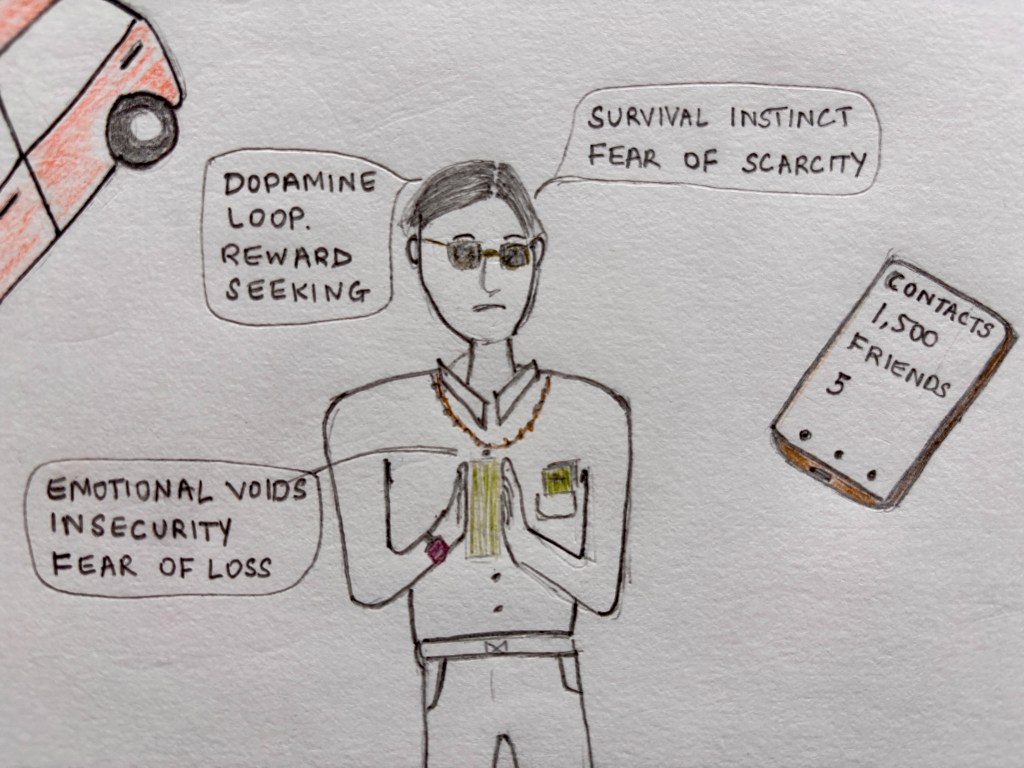
So, “Greed” could also be a misplaced attempt to solve a problem that isn’t actually about money or owning valuable things.
Now, there are thumb rules available for us to determine how much wealth we will need in our lifetime, based on a lifestyle that we seek to maintain. Plus, the law of diminishing returns sets in – beyond a point more wealth does equate to more happiness.
Greed and hoarding may appear similar but the drivers for both these are different. The American Psychiatric Association defines hoarding as a “persistent difficulty in discarding or parting with possessions, regardless of their actual value”. Greed is usually about the pursuit of pleasure and status, while hoarding is about the avoidance of pain and anxiety. Dr. Brian Knutson’s (Stanford University) research using fMRI scans shows that the anticipation of gain (greed/ acquisition) stimulates the brain’s “pleasure center.” Dr. Randy O. Frost and Dr. Gail Steketee discovered that for a hoarder, the act of throwing something away triggers the same brain regions that register physical pain. So, unlike greed, hoarding is a coping mechanism to avoid the pain of losing something.
When Greed becomes dangerous
The formative years, ages 8-12 is where we start “collecting” things that can hold power over our peers – trading cards, shoes, devices. In adolescence, ages 13-19, new to social media, we use every opportunity to show off our ownership of such objects, a period where our fundamental traits are formed.
Greed starts becoming dangerous when it goes beyond being a motivational spark to impacting our well-being in terms of our health and our relationships with people around us. This is when people start seeing other people as tools to achieve their goals or as obstacles to be cleared away. Further, greed and power exist in a symbiotic relationship: while greed is a desire for more resources, wealth or influence; power is the capacity to get it. A person in a powerful position feels less social pressure to conform to social norms. Social psychologist Paul Piff conducted a number of studies that found that as a person’s sense of wealth increases, their compassion and empathy tend to decrease.
Greed is as old as our human civilization and we can find references to it compiled as far back as 600 BCE in the Upanishads (Sanskrit texts that form the philosophy of Hinduism). The most well known exploration of greed versus wisdom is the conversation between Nachiketa, a student keen to learn with no interest in material things and Yama, the God of Death. No amount of material pleasures offered by Yama could dissuade Nachiketa from seeking the answer to the secret of what happens to us after dying. The lesson learnt is that all wealth and pleasures are temporary that distract us from our true self (the Atman) and we should stay focused on our spiritual path.
The first verse of the Isha Upanishad advises us to enjoy things with a sense of renunciation. Greed is illogical for various reasons:
- All the atoms that make up our body or the things around us were always here
- All our wealth is a loan from the universe
- Our body is constantly changing and eventually disappears, so possessing anything is not possible
I came across a beautiful analogy used in Vedanta (philosophy based on the Upanishads): Imagine our lives on earth as a stay for a few days in a hotel room. What is the point in accumulating furniture today when we will be checking out tomorrow morning? The Upanishads see “Greed” as an error that can be proved quantitatively. If Value = Utility X Duration, and Duration at death becomes zero, then the total value of accumulated physical wealth also becomes zero. This pragmatic view is also described in Die With Zero, a book by Bill Perkins encourages an approach to life where we should focus more on creating memorable experiences for ourselves rather than leaving behind a lot of money (from our hard work) and not making use of it in our lifetime. So rather than being rich, focusing on high-status cars, big houses and expensive clothes it’s better to focus on being wealthy, where you have the ability to wake up and say, “I can do whatever I want today.”
The story of King Yayati is one of the most famous parables about the “unquenchable” nature of greed and desire in ancient Indian literature. Cursed by sage Shukracharya, he was struck with premature old age. However, the sage allowed Yayati to regain his youth if he could find someone willing to exchange their youth for his old age. Yayati asked his own sons to make the sacrifice and his youngest son, Puru, agrees out of filial duty. Yayati became young again, while his son became a frail old man. It took Yayati a thousand years to realize that his hunger for wealth, power and sensory enjoyment had become a bottomless pit. Like Yayati taking his son’s youth, this manifests as older generations staying in high-level positions longer than necessary or taking decisions that benefit themselves at the expense of the generations to come. At a more basic level, this is not very far from our own fear of aging and our pursuit of eternal youth.
References to the detrimental effects of greed are also found in other cultures too:
- Greek mythology: The story of King Midas, who wished that everything he touched should turn into gold. He realises his folly when his food turns to gold and he can’t eat it and his daughter turns into a gold statue.
- Nordic Region: Fafnir the Dragon: A story about a dwarf who murders his father to steal cursed gold. His greed transforms him into a dragon to guard his gold, alluding that greed makes us lose our human form and we become cold, like reptiles, just guarding inanimate objects.
Or take a story closer to the present, of a stock-broker in the US, that was made into a movie “The Wolf of Wall Street”
Possession of wealth beyond what we need is like a golden cage. You would spend more time and energy protecting it and you would isolate yourself. With your social expectations, you would believe that someone not as wealthy as you is not worth your time. Wealth and power do matter in a world driven by material pursuit but we must not forget that cooperation with others around us is a better long term survival strategy in the world.
Greed is not good for health in other ways too. When greed and its associated psychological stress of losing status or wealth continue over a long period of time, the release of hormones cortisol and adrenaline and suppression of the immune system leads to insomnia and heart disease.
How can we become aware of our own greed?
Reflecting on our behaviour can help us understand ourselves better. Ask yourself the following questions:
- Did I acquire something only because someone else had it?
- What are all the things that I have purchased and not touched at all or bothered to maintain, let alone using it
- When I pass on, will people say more things about the success and wealth I made for myself or what I meant to them?
- How long would I be upset if my investments declined by 20% but my family members are in good health and safe?
- What will I value most in the long run: spending time with my family or spending extra hours trying to earn more than I really need?
And if your answers indicate that you need to be concerned about greed and how it’s affecting you, here are things that you might want to do:
- Gift something to someone anonymously without the expectation of receiving the credit for your good deed
- Consumption fast: Try not to buy something that you don’t really need for a month. Reflect on what is driving the urge – greed/ anxiety/ sense of power that you have the money to buy what you want or simply boredom.
- Gratitude meditation: Expressing gratitude to people and incidents that have been favourable to us is known to trigger the brain to produce Dopamine, which enhances the feeling of contentment and reduces the levels of the stress hormone Cortisol.
References
https://www.anz.co.nz/personal/private-bank/articles/three-generation-curse/
https://stanford.edu/group/spanlab/Press/bk082307press.html
https://www.pnas.org/doi/10.1073/pnas.1118373109
Does money make you mean? | Paul Piff
Why Zebras Don’t Get Ulcers – Robert M. Sapolsky
 Yogalaya Singapore