When we see someone in distress, how we respond says a lot about us. Are we able to fully understand the situation that someone else is in? And we are able to offer some support or at least express our concern to them? In an increasingly digitized and polarized world, where everyone is busy, we cannot ignore the essential glue of society: empathy. Often confused with sympathy or pity, empathy is much more than feeling “sorry” for someone. It is the our capacity to understand and share the feelings of another—to step outside of our own skin and view the world through another person’s eyes.
What is Empathy?
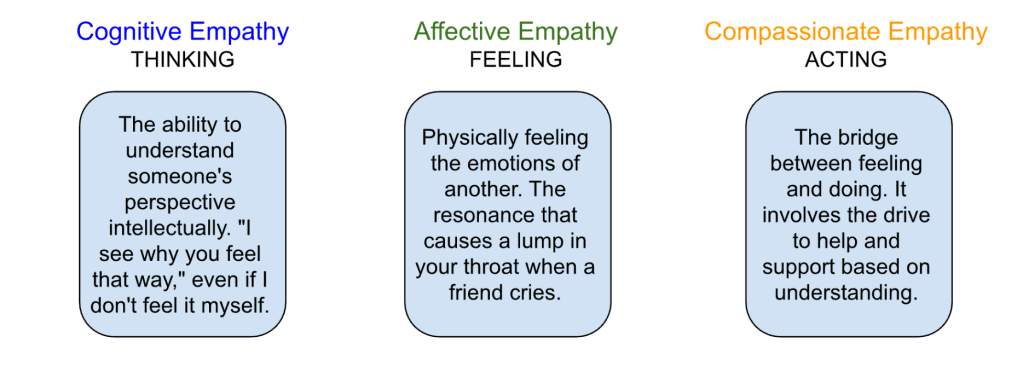
Psychologists generally categorize empathy into three distinct types, each serving a different function in human interaction:
The Foundations: Biology and Evolution
Empathy is not merely a social construct; it is hardwired into our biology and evident across the animal kingdom. Neuroscientists have discovered mirror neurons – specialized cells that fire both when we perform an action and when we observe someone else doing the same. For example, when you see someone stub their toe, the pain centers in your brain flicker in response.
Primatologist Frans de Waal suggests empathy follows a “Russian Doll” model. At its core is “emotional contagion” (mice and dogs will mimic behaviour of other mice and dogs when stressed or afraid), which evolves into “consolation behavior” (seen in elephants and great apes), and eventually into full perspective-taking.
- Apes: Chimpanzees often hug or groom victims of an attack to calm them.
- Rats: Experiments show rats will forgo treats to free a trapped companion.
- Elephants: Known to stay with dying herd members and return to the bones of deceased relatives, showing sophisticated emotional resonance.
Among humans, empathy evolves as we grow, shaped by both age and experience.
- Infants: Babies demonstrate “emotional contagion,” reflexively crying when others cry.
- Toddlers (18-24 months): As children develop a “sense of self,” they begin to offer comfort, like sharing a toy.
- Early Childhood (3–6 years): Cognitive Empathy
Children start to understand that other people have thoughts and feelings different from their own. This shift enables more deliberate perspective-taking, though it is still rudimentary and inconsistent. - Middle Childhood to Adolescence (7–18 years): By age 7, children begin to empathize with people they haven’t met, such as characters in stories or distant social groups. The ability for abstract reasoning allows for empathy on broader societal issues like justice and poverty.
- Adulthood: Empathy tends to peak in middle age (50s-60s) as our life experiences provide a broader library of emotions to draw from. While the speed of “cognitive empathy” may slow in later years, the emotional depth of “affective empathy” often remains robust. We may even be more compassionate and donate to the needy.
What makes someone a more empathetic person?
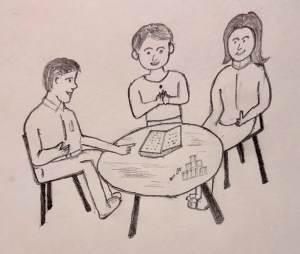
Whether we are more or less empathetic is a function of how we are brought up, how our role models behave and our own life experiences.
- Sense of security: Children with responsive caregivers tend to have higher empathy. Simply put, once our own needs are met, we are in a better position to care for others.
- Role models: We learn by watching. Parents and teachers who coach their children/ students to understand their emotions and label their feelings will grow up to be more empathetic
- Adversity: Surviving hardships often creates a “shared emotional vocabulary,” increasing resonance with the pain of others. People with fewer resources will pay more attention to social cues and emotions of those around them and offer support in anticipation of reciprocal response. Being affluent may not lead to this social pressure as they can afford to pay for the services they need.
Our capacity to be empathetic is finite. Research by Charles Figley demonstrated that individuals who are constantly exposed to the suffering of others (such as nurses, social workers, first responders) develop symptoms nearly identical to PTSD, including intrusive thoughts, insomnia, and chronic irritability. His work established that empathy is a finite resource that can be “depleted” if the individual does not have adequate “empathic distance.”
Contextual Influences: Culture and Media
Culture and media are powerful influences that shape our thinking on so many aspects including empathy. By the time we are adults and understand the concept of empathy some of our behaviour is hard wired. The media can play a powerful role in making the world more kind, more empathetic. The danger is that it can also lead to “empathy fatigue”.
- Cross-Cultural Variations: In collectivist cultures (often in Asia, Latin America, and Africa), empathy is often tied to social harmony and group cohesion. In individualist cultures (like North America and Western Europe), empathy is more focused on personal connections and individual rights.
The Hindu philosophy makes several references to empathy:
- The “Atman” is the same divine spark that resides in everyone – so the joys and sorrows of others are also our own
- “Vasudhaiva Kutumbakam”: The world is one family and our empathy should extend to all living beings
- “Karuna” (also in Buddhist philosophy) refers to active compassion that arises from seeing the suffering of others and recognizing it as a part of universal human condition
- The Role of Narrative

- The media we consume acts as a primary trainer for our empathy. Digital algorithms on social media platforms can cause empathy for minorities and disadvantaged to wither by only showing us stories that reinforce our existing biases (filter bubbles). On the other hand, literary fiction, biographies and films act as empathy simulators, allowing us to “practice” living multiple lives and breaking down “otherness.”
- News is particularly powerful where distressing images and videos have a direct impact on our amygdala (brain centre that governs our response to stress) and mirror neurons. In such cases, it is important to understand the tragedies without our nervous system being hijacked.
- Further, the volume of negative news and amplification through social media can be overwhelming. In order to protect itself, our brains start to mute our “empathic response” or we might encounter “empathic fatigue”
- News media do need to report the crimes and disasters but should not leave the reader or viewer with a feeling of helplessness. They need to also cover action taken by police, civil defence, contribution of rescuers and other volunteers in case of disasters.
Countering Empathic Fatigue and Fostering The Spirit of Community
True empathy requires tailoring our approach to the specific people in our lives, especially during “threshold moments.”
1. Staying in touch with friends and family
- Sending a message with content and tone that does not require someone to immediately respond can make them feel positive. For the elderly, empathy could simply mean listening with genuine curiosity to their stories. For neighbours, simply asking if they needed anything from a nearby store might be of help.
- Listen and mirror the feeling in conversations instead of reacting or immediately offering a solution that may not be appropriate.
- Pay extra attention to people managing transitions such as relocation, a job loss or a divorce. Acknowledge the hidden anxiety beneath the surface of the event.
- Follow up post crisis: Usually, there is more support immediately after a crisis. It is important to show up in the second month when everyone gets busy with their own lives but the pain remains for those affected.
2. Supporting colleagues: Safety and Failure
- Check-ins: Start meetings with casual conversations to sense participants energy levels rather than going straight to the status report.
- Contextual Awareness: If a coworker is underperforming, consider what unseen struggles might be occurring in their personal life.
- Responding to Shame: When a colleague admits a mistake, respond with empathy and build psychological safety.
Managing the Challenges: Empathy Fatigue
Constant exposure to challenging global and local issues can lead to “Empathy Fatigue”—emotional exhaustion that causes us to shut down.
- Visuals vs. Volume: Visceral images trigger immediate, draining emotional responses. However, the sheer volume of negative news is the primary driver of chronic stress.
- Countering Fatigue: Shift from “feeling with” (Affective) to “understanding for” (Cognitive). Set boundaries on “doom scrolling” and move toward
- Solutions Journalism: Media can help by highlighting community responses and providing paths to assistance rather than just reporting trauma.
Self-Directed Growth Strategies

You can strengthen your empathy “muscle” independently through intentional practice:
- Meditation techniques based on Buddhist traditions: Compassion meditation (CM) and Loving-kindness meditation (also known as Metta) have been shown to physically increase gray matter in brain regions associated with empathy.
- The “Strangers Project”: Strike up conversations with people outside your social circle to broaden your perspectives about life and its challenges.
- Cultural Immersion: Stepping into a world where you are the “outsider” sharpens your social observation and cognitive empathy.
- Compassionate Empathy – focusing on warmth and care by taking small, tangible actions (donating or volunteering) without simulating pain.
Conclusion: The Benefits of an Empathic Life
Choosing empathy isn’t just a gift to others; it transforms the self. It builds stronger, more authentic relationships and provides the tools for effective conflict resolution. In leadership, it fosters morale and retention. Ultimately, stepping into another person’s shoes allows us to break free from our own biases. By choosing to understand rather than judge, we can all make the world a slightly more connected, kinder and a peaceful place to live. It’s something that we owe to those coming into the world today.
References
The ‘Russian doll’ model of empathy and imitation.
Speaking of Psychology: The decline of empathy and the rise of narcissism, with Sara Konrath, PhD
 Yogalaya Singapore